Signed in as:
filler@godaddy.com
Signed in as:
filler@godaddy.com
The principles behind good knowledge management, architecture, provenance, security and semantic representation have developed over decades.
Acta Laurel therefore does not treat every new AI or data trend as a new discipline. Where established research, standards or specifications already exist, we use them.
Where Acta Laurel makes its own architectural decisions, we say so clearly.
Research gives us foundations. Standards give us shared rules. Architecture turns both into something practical.
Not every source has the same purpose.
Acta Laurel separates architectural authority into three categories.
RESEARCH ──► concepts & principles
│
STANDARDS ──► technical consistency
│
ACTA LAUREL ARCHITECTURE ──► practical implementation
We use academic research to understand established concepts, terminology and theoretical foundations.
We use standards where interoperability, architecture description, provenance or technical behaviour needs to be defined consistently.
Some decisions are necessarily architectural choices.
A research paper does not tell an organisation exactly how to structure a repository, name a folder or separate one client from another.
Those decisions belong to the architecture.
Many technology concepts become confusing because research, industry terminology and product marketing are mixed together. A vendor may use a recognised term in a very specific way. A consultancy may introduce its own model. A research community may use the same term differently.
Our approach is simple:
Do not present an architectural preference as scientific fact.
If a concept comes from research, we reference the research. If behaviour comes from a standard, we reference the standard.
If Acta Laurel designed it, we identify it as an Acta Laurel architectural decision.
This makes the architecture easier to challenge, improve and trust.
Knowledge architecture starts with Knowledge Management.
One of the most influential foundations for our approach is the work of Maryam Alavi and Dorothy Leidner.
Their research describes four fundamental Knowledge Management processes:
KNOWLEDGE CREATION ──► STORAGE & RETRIEVAL ──► TRANSFER ──► APPLICATION
│
└──────────► creates new knowledge
This is important because knowledge management is not simply about storing documents.
Knowledge has to be created, preserved, transferred and ultimately applied.
Alavi, M. & Leidner, D.E. (2001).
Review: Knowledge Management and Knowledge Management Systems: Conceptual Foundations and Research Issues.
MIS Quarterly, 25(1).
DOI: 10.2307/3250961
Not everything an organisation knows can be stored in a system. People carry experience, intuition, judgement and skills that are difficult to fully express. This is commonly discussed through the distinction between tacit and explicit knowledge.
HUMAN EXPERIENCE ── articulation ──►EXPLICIT KNOWLEDGE ──► DOCUMENTED &
MANAGEABLE KNOWLEDGE
The Knowledge Lake therefore does not claim to store all human knowledge.
It manages explicit representations of knowledge that people and organisations choose to preserve.
Nonaka, I. (1994).
A Dynamic Theory of Organizational Knowledge Creation.
Organization Science, 5(1).
DOI: 10.1287/orsc.5.1.14
The term Knowledge Lake has academic prior art. It was not created by Acta Laurel.
Beheshti and colleagues introduced the Knowledge Lake as a contextualised extension of the Data Lake, combining data with additional context and knowledge-oriented capabilities.
Their work included areas such as:
Acta Laurel builds on that concept but gives it a particular architectural focus. Our specialisation centres on portable explicit knowledge and the source artefacts from which that knowledge derives.
Beheshti, S.-M.-R., Benatallah, B., Nouri, R. & Tabebordbar, A. (2018).
CoreKG: a Knowledge Lake Service.
Proceedings of the VLDB Endowment, 11(12).
DOI: 10.14778/3229863.3236230
Acta Laurel describes its work as a Reference Architecture deliberately. A Reference Architecture provides a reusable architectural foundation for a class of systems. It is not the final architecture for every organisation.
Instead:
REFERENCE ARCHITECTURE
│
├────────► Organisation A
│
├────────► Organisation B
│
└────────► Engagement C
The common principles remain stable while each implementation adapts to its own requirements.
This supports the Acta Laurel approach of having a small common core with Personal, Enterprise and Engagement profiles.
Angelov, S., Trienekens, J.J.M. & Grefen, P. (2012).
A framework for analysis and design of software reference architectures.
Information and Software Technology, 54(4).
DOI: 10.1016/j.infsof.2011.11.009
Architecture should be described from the perspective of the people and systems that care about it.
Acta Laurel therefore aligns its architecture work with the concepts established in:
ISO/IEC/IEEE 42010:2022
The standard provides recognised terminology around:
views.
This gives us a stronger foundation than inventing our own meaning for words such as architecture, view or stakeholder.
The term Knowledge Warehouse also has a research history.
It should not simply mean:
"the good documents in the Knowledge Lake"
Nemati and colleagues described a Knowledge Warehouse as an architecture integrating Knowledge Management with ideas from Data Warehousing, Decision Support and Artificial Intelligence.
Acta Laurel therefore treats the Knowledge Warehouse as the enterprise capability layer through which organisational knowledge is captured, organised, retrieved, shared and applied.
Nemati, H.R., Steiger, D.M., Iyer, L.S. & Herschel, R.T. (2002).
Knowledge warehouse: an architectural integration of knowledge management, decision support, artificial intelligence and data warehousing.
Decision Support Systems, 33(2).
DOI: 10.1016/S0167-9236(01)00141-5
Knowledge Graphs provide a way to represent entities, concepts and their relationships explicitly.
They become useful when an organisation needs to answer questions involving connections rather than only documents.
For example:
PERSON ──►TEAM ── owns ──► SYSTEM ── supports ──►CAPABILITY
Acta Laurel distinguishes a simple Concept Link Graph from a richer Knowledge Graph.
A mature Knowledge Graph may introduce stable identity, typed relationships, schemas, provenance, constraints and semantic models.
Hogan, A. et al. (2021).
Knowledge Graphs.
ACM Computing Surveys, 54(4).
DOI: 10.1145/3447772
Terminology matters. But not every list of business terms should be called an ontology.
Acta Laurel starts with the simplest useful structure. A controlled vocabulary can define things such as:
Formal ontology becomes appropriate only when richer semantic modelling is actually required. This distinction is supported by established knowledge-engineering literature.
Gruber, T.R. (1993).
A translation approach to portable ontology specifications.
Knowledge Acquisition, 5(2).
DOI: 10.1006/knac.1993.1008
Studer, R., Benjamins, V.R. & Fensel, D. (1998).
Knowledge engineering: Principles and methods.
Data & Knowledge Engineering, 25.
DOI: 10.1016/S0169-023X(97)00056-6
Names are useful for people.
They are not always reliable identifiers.
Two policies may have the same title.
Two people may have the same name.
One system may change its name while still being the same system.
Knowledge architecture therefore needs to distinguish:
what something is
from:
what we currently call it
Work around semantic knowledge organisation, including SKOS, reinforces this distinction between concepts and labels.
Baker, T. et al. (2013).
Key choices in the design of Simple Knowledge Organization System (SKOS).
Journal of Web Semantics, 20.
DOI: 10.1016/j.websem.2013.05.001
Knowing something is useful. Knowing where it came from is often more important.
Acta Laurel uses two levels of provenance.
A Knowledge Concept can identify the source material from which it derives.
More complex environments may also need to capture:
For this richer model, we use the concepts established by W3C PROV. W3C PROV models provenance using three central ideas:
Entities
Activities
Agents
This provides a recognised model for lineage beyond simple document references.
Portable knowledge needs a practical representation.
Acta Laurel currently uses the Open Knowledge Format — OKF as its primary representation approach for portable Knowledge Concepts and Knowledge Bundles.
OKF is deliberately lightweight.
It uses human-readable content and structured metadata rather than requiring a specialised platform simply to understand the knowledge.
Important concepts include:
Acta Laurel adopts these terms rather than redefining them unnecessarily.
This supports a core architectural principle:
Knowledge should remain understandable outside the application currently displaying it.
Security labels alone do not secure information. A file containing:
classification: confidential
is not protected merely because the metadata says so.
Authorisation must be enforced by the system that stores or distributes the knowledge.
This may involve:
The architecture is also influenced by the long-established security principle of least privilege: access should be limited to what is needed to perform the required function.
Saltzer, J.H. & Schroeder, M.D. (1975).
The Protection of Information in Computer Systems.
Proceedings of the IEEE, 63(9).
DOI: 10.1109/PROC.1975.9939
Not every part of the Knowledge Lake Reference Architecture appears in a research paper.
That is intentional.
Research gives us concepts.
It does not prescribe the exact architecture required by a particular organisation.
The following are examples of Acta Laurel architectural decisions and conventions:
These decisions are informed by the underlying research and standards, but they remain architectural choices.
We believe that distinction should always be visible.
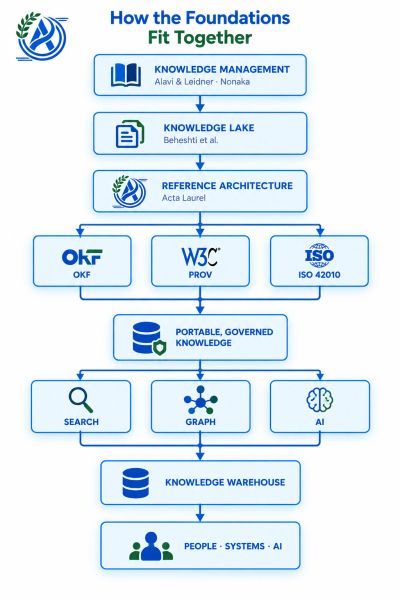
The full approach can be summarised simply in the diagram. The important point is not the diagram itself. It is that each layer solves a different problem. Knowledge Management research explains how knowledge is created and used. Knowledge Lake research provides architectural precedent. Standards and specifications provide common models and terminology.
The Acta Laurel Reference Architecture turns those foundations into a practical design.
Acta Laurel does not claim that research has already solved every practical knowledge problem.
It has not. Nor do we believe organisations should wait for a perfect universal model before improving how their knowledge is managed.
Our approach is to use established knowledge where it exists, keep architectural assumptions visible and introduce complexity only when the problem requires it.
That means:
For readers who want to explore the academic and technical foundations in greater depth, the principal sources used throughout the Acta Laurel Knowledge Architecture include:
Knowledge Management
Alavi & Leidner (2001) — DOI 10.2307/3250961
Organisational Knowledge Creation
Nonaka (1994) — DOI 10.1287/orsc.5.1.14
Knowledge Lake
Beheshti et al. (2018) — DOI 10.14778/3229863.3236230
Knowledge Warehouse
Nemati et al. (2002) — DOI 10.1016/S0167-9236(01)00141-5
Reference Architecture
Angelov, Trienekens & Grefen (2012) — DOI 10.1016/j.infsof.2011.11.009
Knowledge Graphs
Hogan et al. (2021) — DOI 10.1145/3447772
Ontology
Gruber (1993) — DOI 10.1006/knac.1993.1008
Knowledge Engineering
Studer, Benjamins & Fensel (1998) — DOI 10.1016/S0169-023X(97)00056-6
Knowledge Organisation / SKOS
Baker et al. (2013) — DOI 10.1016/j.websem.2013.05.001
Security
Saltzer & Schroeder (1975) — DOI 10.1109/PROC.1975.9939
Architecture Description
ISO/IEC/IEEE 42010:2022
Provenance
W3C PROV Data Model
Portable Knowledge Representation
Open Knowledge Format
Knowledge Management existed before generative AI. Knowledge Graphs existed before large language models. Provenance existed before RAG. Enterprise Architecture existed before cloud platforms. Security principles existed before SaaS. The technologies are changing. Many of the underlying problems are not.
Acta Laurel's objective is therefore not to invent a new vocabulary for every technology cycle. It is to combine established thinking with modern engineering in a form organisations can actually use.
Build on research. Follow standards where they help. Make architectural decisions explicit. Keep the knowledge durable.
Copyright © 2026 Acta Laurel - All Rights Reserved.
We use essential cookies to operate this website and, with your consent, optional analytics and third-party cookies to understand how our website is used, improve its performance and measure our services. You can accept or reject optional cookies. Rejecting optional cookies will not affect essential website functionality. For more information, please see our Privacy Policy and Cookie Policy.