ACTA LAUREL
ACTA LAUREL
  • Home
  • SERVICES
    • What Services We Offer
    • ActaAI
    • ActaComply
    • ActaData
    • ActaOpen
    • ActaPulse
    • ActaShield
  • KNOWLEDGE
    • Overview
    • Business Value
    • Knowledge Lake
    • Reference Architecture
    • Knowledge Warehouse
    • Knowledge Graph
    • Research & Standards
  • INSIGHTS
    • Our Products
    • Open Source
    • Analytics
    • IT Development
    • Data Engineering
    • AI Implementation
    • IT in Business
    • Good Reads (External)
  • COMPANY
    • About Us
  • PARTNERS
    • OpenAI
  • Shop
  • More
    • Home
    • SERVICES
      • What Services We Offer
      • ActaAI
      • ActaComply
      • ActaData
      • ActaOpen
      • ActaPulse
      • ActaShield
    • KNOWLEDGE
      • Overview
      • Business Value
      • Knowledge Lake
      • Reference Architecture
      • Knowledge Warehouse
      • Knowledge Graph
      • Research & Standards
    • INSIGHTS
      • Our Products
      • Open Source
      • Analytics
      • IT Development
      • Data Engineering
      • AI Implementation
      • IT in Business
      • Good Reads (External)
    • COMPANY
      • About Us
    • PARTNERS
      • OpenAI
    • Shop
  • Sign In
  • Create Account

  • Bookings
  • Orders
  • My Account
  • Signed in as:

  • filler@godaddy.com


  • Bookings
  • Orders
  • My Account
  • Sign out


Signed in as:

filler@godaddy.com

  • Home
  • SERVICES
    • What Services We Offer
    • ActaAI
    • ActaComply
    • ActaData
    • ActaOpen
    • ActaPulse
    • ActaShield
  • KNOWLEDGE
    • Overview
    • Business Value
    • Knowledge Lake
    • Reference Architecture
    • Knowledge Warehouse
    • Knowledge Graph
    • Research & Standards
  • INSIGHTS
    • Our Products
    • Open Source
    • Analytics
    • IT Development
    • Data Engineering
    • AI Implementation
    • IT in Business
    • Good Reads (External)
  • COMPANY
    • About Us
  • PARTNERS
    • OpenAI
  • Shop

Account

  • Bookings
  • Orders
  • My Account
  • Sign out

  • Sign In
  • Bookings
  • Orders
  • My Account

Knowledge Lake Reference Architecture

A reusable blueprint for durable knowledge infrastructure

Every organisation manages knowledge differently.


Its people, terminology, security requirements, technologies, regulatory obligations and operating model are different.


A durable knowledge architecture therefore cannot prescribe one universal repository structure or technology stack.


Acta Laurel's Knowledge Lake Reference Architecture provides a common architectural foundation from which different Knowledge Lake implementations can be designed.


It defines a deliberately small core, establishes architectural principles and allows additional capabilities to be introduced through deployment profiles.

One reference architecture. Different implementations. A common foundation for organisational knowledge.

Contact Us

What Is a Reference Architecture?

A reference architecture is not the architecture of one particular system.


It provides a reusable architectural foundation for a class of systems.


A concrete architecture applies that foundation to a particular organisational context.


This distinction is important.


The Reference Architecture does not dictate how every organisation must organise its knowledge.


It establishes the architectural concepts and constraints within which appropriate implementations can be created.
Why a Reference Architecture?

Without a common architecture, knowledge environments tend to evolve independently.


One team uses SharePoint.


Another uses a wiki.


Technical knowledge sits in Git.


Policies live in a document-management system.


Projects accumulate files in collaboration platforms.


Individuals maintain their own notes.


AI teams create separate vector databases and retrieval pipelines.


Each system may work individually while the organisation lacks a coherent knowledge foundation.


A Reference Architecture provides a common architectural language across these environments.

The objective is not technological uniformity.


The objective is architectural consistency.

It establishes:

  • what constitutes durable knowledge;
  • how source material relates to knowledge;
  • how knowledge is represented;
  • where working material belongs;
  • how provenance is preserved;
  • how terminology can be governed;
  • how ownership boundaries are established;
  • how different technologies can consume the same knowledge.

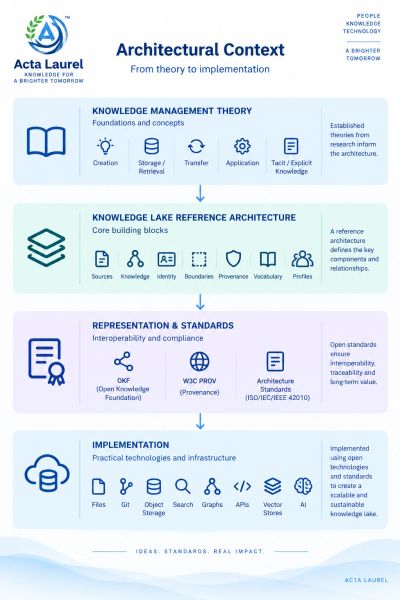
Architectural Context

The Reference Architecture sits between Knowledge Management principles and concrete technology implementations.

Each layer has a different responsibility.


Research provides conceptual foundations.


Standards and specifications provide formal models and interoperability.


The Reference Architecture translates those foundations into architectural decisions.


Technology implements them.
The Architectural Core

The Reference Architecture deliberately begins with a very small required structure.


<knowledge-lake>/

│

├── lake.yaml

│

├── sources/

│

└── knowledge/

    └── index.md


These represent three fundamental architectural concerns:


Lake identity and configuration


Source artefacts


Explicit knowledge


Everything else should justify its existence.

Lake Definition

lake.yaml


Every Knowledge Lake requires an identity.


The lake definition describes the Knowledge Lake itself rather than an individual Knowledge Concept.


It can establish information such as:


  • name
  • identifier
  • owner
  • purpose
  • profile
  • version
  • governance


The precise schema can evolve as the formal specification matures.


The important architectural principle is that the lake itself is an identifiable, governable entity.


This becomes particularly important when an organisation operates multiple Knowledge Lakes.

Source Layer

sources/


The source layer preserves material from which knowledge may derive or to which knowledge may refer.


sources/

│

├── documents/

├── data/

├── media/

└── ...


The Reference Architecture does not require those particular subdirectories.


They illustrate one possible implementation.


Source artefacts can include:


  • documents;
  • research;
  • standards;
  • contracts;
  • exports;
  • correspondence;
  • presentations;
  • media;
  • datasets;
  • external material.


The architectural requirement is the distinction between source material and explicit knowledge representation, not a prescribed taxonomy of file types.

Knowledge Layer

knowledge/


The knowledge layer contains the durable explicit knowledge corpus.


knowledge/

│

├── index.md

├── concept-a.md

├── concept-b.md

└── ...


Acta Laurel currently adopts the Open Knowledge Format as the primary representation model for this layer.


Knowledge is organised into addressable concepts and Knowledge Bundles using portable, human-readable representations.


The architecture deliberately avoids requiring a central database merely to understand the canonical knowledge corpus.


Applications may create databases and indexes over that corpus.


They do not necessarily become the knowledge itself.

The Minimal Core Principle

A Reference Architecture becomes less reusable when every implementation decision is made mandatory.


The Acta Laurel approach therefore follows a principle of:


Minimal core. Explicit extensions. Context-specific profiles.


The core establishes what must remain consistent.


Profiles establish conventions appropriate to particular environments.


Implementations decide how those conventions are realised using technology.

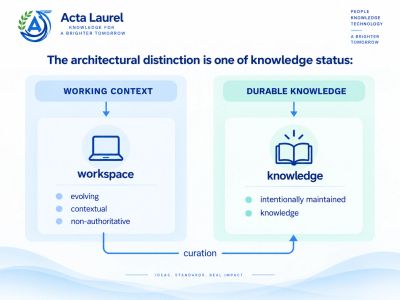
Optional Workspace

Some Knowledge Lakes benefit from maintaining working material close to the durable knowledge environment.


For those environments, the Reference Architecture permits:


workspace/


For example:


workspace/

├── inbox/

├── meetings/

├── initiatives/

└── scratch/


These directories are conventions rather than universal requirements.


Workspace artefacts are non-authoritative by default.


They may still be searched, analysed or supplied to an AI system when appropriate.

Curation is possible.


Mandatory promotion is not required.


Knowledge may also be created directly within knowledge/.
Optional Vocabulary

Welcome to Acta Laurel!

Where terminology requires governance, the architecture permits:


vocabulary/

├── types.yaml

├── tags.yaml

└── relationships.yaml


Again, these filenames are implementation conventions rather than universal requirements.


The purpose is to provide a place for controlled terminology and semantic constraints.


A Knowledge Lake may begin with a simple controlled vocabulary and evolve toward richer knowledge organisation structures where justified.

The Reference Architecture does not require semantic complexity before there is a business need for it.

Strucutre

CONTROLLED VOCABULARY 

  │ 

TAXONOMY 

  │ 

KNOWLEDGE ORGANISATION SYSTEM 

  │ 

FORMAL ONTOLOGY

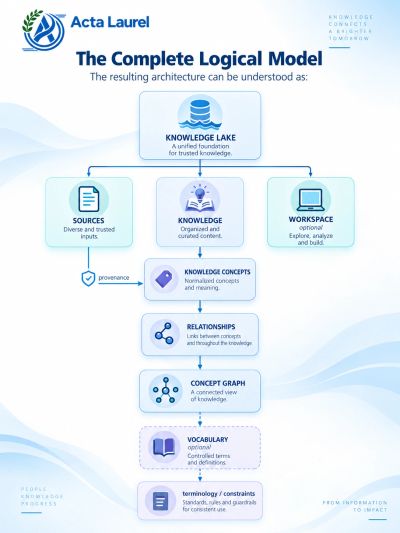
The Complete Logical Model

This is the logical architecture.


A concrete implementation can distribute these concerns across different technologies while retaining the same conceptual model.

Canonical Knowledge and Derived Infrastructure

One of the most important architectural distinctions is between canonical knowledge and derived infrastructure.


The Knowledge Lake contains the durable knowledge assets.


Systems can derive specialised representations from those assets.


                                KNOWLEDGE LAKE

                                               │

                                 Canonical Knowledge

                                                │

       ┌─────────────────┼──────────────────┐

       │                                       │                                        │

       ▼                                     ▼                                       ▼

 SEARCH INDEX            VECTOR INDEX              GRAPH DATABASE

       │                                       │                                        │

       └─────────────────┼──────────────────┘

                                                │

                                               ▼

                                 APPLICATIONS & AI


Search indexes can be rebuilt.


Embeddings can be regenerated.


Vector databases can be replaced.


Graph technologies can change.


AI models can change.


The organisation should not lose its canonical knowledge because a derived technology was replaced.


This is a central principle of the Reference Architecture.

Knowledge Representation

Portability requires a representation model.


Acta Laurel currently uses the Open Knowledge Format (OKF) for the knowledge layer.


OKF provides concepts such as:


Concept


An addressable unit of knowledge.


Concept ID


Stable concept identity within a Knowledge Bundle.


Knowledge Bundle


A portable collection of related Knowledge Concepts.


Source


Material from which a concept derives.


Provenance


Source information associated with the concept.


Status


Lifecycle information such as draft, stable or deprecated.


These terms should be inherited from OKF rather than independently redefined by the Reference Architecture.


This reduces unnecessary invention and improves interoperability.

Provenance

The Reference Architecture requires knowledge and source material to be capable of remaining connected.


At the baseline:


SOURCE ARTEFACT

      │

      │ derives / supports

      ▼

KNOWLEDGE CONCEPT


OKF provides a lightweight mechanism for recording sources.


Some enterprise environments require richer lineage:


ENTITY

   │

   ▼

ACTIVITY ◄──────── AGENT

   │

   ▼

ENTITY


For those environments, the architecture can adopt provenance aligned with W3C PROV.


This creates a deliberate maturity path:


Source Reference

       │

       ▼

Source Provenance

       │

       ▼

Activity Lineage

       │

       ▼

Rich Provenance Model


Not every Knowledge Lake needs the most sophisticated model.

Architectural Boundaries

The Reference Architecture does not assume that all knowledge belongs in one repository.


A Knowledge Lake should represent a meaningful ownership, governance or security boundary.


For example:


ENTERPRISE

│

├── Corporate Knowledge Lake

│

├── Research Knowledge Lake

│

└── Engagement Knowledge Lakes

    ├── Client A

    ├── Client B

    └── Client C


The appropriate boundary depends on factors including:


  • ownership;
  • confidentiality;
  • legal entity;
  • contractual restrictions;
  • regulatory requirements;
  • administrative responsibility;
  • lifecycle;
  • portability requirements.


This is particularly important for consulting organisations managing client knowledge.


A client's knowledge should not become inseparably mixed with the consultancy's corporate knowledge simply because both use the same tooling.

Security Model

The Reference Architecture separates classification from authorisation.


Metadata may describe:


classification: confidential


but that metadata does not enforce access.


Actual security belongs to the hosting and distribution environment.


          KNOWLEDGE METADATA

                 │

                 ▼

        describes classification

                 │


        HOSTING ENVIRONMENT

                 │

                 ▼

       enforces authorisation

                 │

       ┌─────────┼─────────┐

       ▼         ▼         ▼

      IAM       ACLs    Encryption


This allows the architecture to work across different technology environments while maintaining a clear security principle.


Where security boundaries differ materially, separate Knowledge Lakes may be preferable.

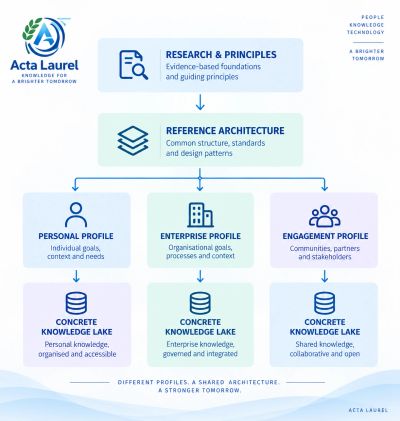
Deployment Profiles

The Reference Architecture defines a common core.


Profiles adapt that core to different operating contexts.


Acta Laurel currently identifies three primary profiles.

Personal Profile

The Personal Profile applies the architecture to Personal Knowledge Management.


For example:


Personal/

│

├── lake.yaml

├── sources/

├── knowledge/

│   ├── index.md

│   ├── life/

│   ├── people/

│   ├── interests/

│   └── decisions/

│

└── workspace/

    ├── inbox/

    ├── daily/

    ├── projects/

    └── scratch/


The categories shown are implementation choices.


They are not part of the normative Reference Architecture.


A person's classification system should reflect how that individual works.


The architecture supplies the foundation without prescribing a lifestyle methodology.

Enterprise Profile

The Enterprise Profile introduces stronger concerns around stewardship, shared terminology, organisational domains and governance.


A possible implementation is:


Enterprise/

│

├── lake.yaml

├── sources/

│

├── knowledge/

│   ├── index.md

│   │

│   ├── shared/

│   │   ├── glossary/

│   │   ├── people/

│   │   ├── systems/

│   │   ├── policies/

│   │   └── standards/

│   │

│   └── domains/

│       ├── strategy/

│       ├── finance/

│       ├── operations/

│       ├── technology/

│       └── data-ai/

│

├── vocabulary/

│

└── workspace/


The distinction between shared/ and domains/ is an Acta Laurel Enterprise Profile convention.


It is not the definition of a Knowledge Lake.


shared/ contains knowledge intentionally reusable across organisational boundaries.


domains/ provides areas in which stewardship belongs primarily to a particular business domain.


Concrete organisations can adapt the domain model to their operating structure.

Engagement Profile

Consulting, programmes, partnerships and client engagements create a distinct architectural problem.


Knowledge may be produced collaboratively while ownership and access remain bounded.


The Engagement Profile treats that boundary explicitly.


Client-Engagement/

│

├── lake.yaml

├── sources/

├── knowledge/

├── workspace/

└── vocabulary/


The structure may resemble an Enterprise Knowledge Lake.


The difference is primarily its ownership and governance context.


An Engagement Knowledge Lake can therefore remain independently portable.


At engagement completion, the knowledge can be:


  • transferred;
  • archived;
  • retained according to agreement;
  • integrated into the client's environment;
  • selectively incorporated into reusable consultancy knowledge where permitted.


This avoids treating client knowledge as merely another folder inside an internal consultancy repository.
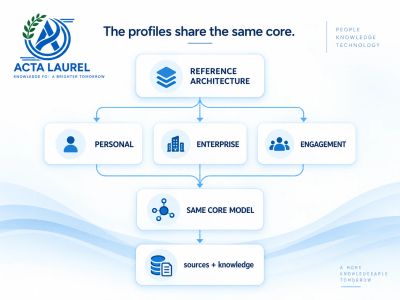
Profiles Are Not Separate Architectures

The profiles share the same core.

This creates consistency without requiring identical implementations.

Conformance

As the formal specification develops, it is important to distinguish between architectural requirements and recommendations.


The Reference Architecture should eventually use conventional normative language:


MUST

Required for conformance.


SHOULD

Recommended unless a justified reason exists not to follow it.


MAY

Optional.


For example:


  • A Knowledge Lake MUST contain a knowledge corpus.


  • A Knowledge Lake MAY contain a workspace.


  • An Enterprise Profile SHOULD establish explicit stewardship.


This distinction prevents architectural preferences from accidentally becoming universal requirements.


The public website explains the architecture.


A separate formal specification should eventually define exact conformance rules.

What the Reference Architecture Does Not Prescribe

The architecture deliberately avoids prescribing technology unnecessarily.


It does not require:


Git


Git may be an excellent implementation choice for versioning, but version control technology is not part of the conceptual definition.


Obsidian


Obsidian can provide an effective human interface over a file-oriented Knowledge Lake, particularly for Personal Knowledge Management, but it is an implementation tool.


A vector database


Vector retrieval is derived infrastructure.


A graph database


A Knowledge Graph may be derived or maintained where appropriate.


A specific cloud provider


The architecture should remain deployable across local, private-cloud and public-cloud environments.


A mandatory ontology


Controlled vocabulary may be sufficient.


One universal folder taxonomy


Classification should reflect the deployment context.


One central enterprise repository


Knowledge boundaries should follow governance, ownership and security requirements.


This deliberate restraint is what keeps the architecture portable.
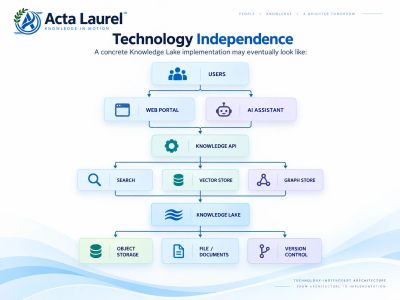
Technology Independence

A concrete Knowledge Lake implementation may eventually look like:

Another implementation may use entirely different products.


Both can conform to the same Reference Architecture if they preserve the relevant architectural concepts and constraints.
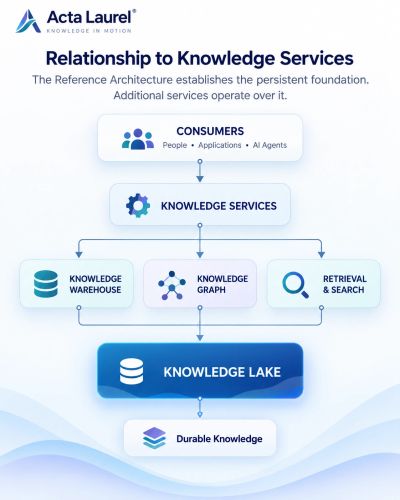
Relationship to Knowledge Services

The Reference Architecture establishes the persistent foundation.

Additional services operate over it.

This separation prevents the architecture from confusing the knowledge asset with the services used to consume it.

Architectural Principles

The Acta Laurel Knowledge Lake Reference Architecture is guided by several principles.


Knowledge before tooling


Technology should support the knowledge architecture rather than define it.


Portability before platform dependency


Knowledge should remain recoverable outside the product currently managing it.


Explicit knowledge has identity


Knowledge Concepts should be addressable independently of human-readable labels.


Sources remain traceable


Durable knowledge should retain appropriate connections to its origins.


Working context is not automatically authoritative


Workspace material can be useful without being treated as established knowledge.


Governance follows ownership


Knowledge boundaries should reflect real responsibility, confidentiality and lifecycle.


Metadata describes; systems enforce


Security labels do not replace access control.


Semantic complexity must earn its place


Controlled vocabulary should not become an ontology merely because an ontology sounds more sophisticated.


Derived infrastructure is replaceable


Search indexes, embeddings, graph projections and AI representations should be reproducible where practical.


The core remains small


Optional sophistication should not make simple implementations impossible.

From Reference Architecture to Implementation

A Reference Architecture only creates value when it can be translated into a working environment.


Acta Laurel approaches implementation progressively.


UNDERSTAND

    │

    ▼

BOUNDARIES

    │

    ▼

KNOWLEDGE MODEL

    │

    ▼

ARCHITECTURE

    │

    ▼

IMPLEMENTATION

    │

    ▼

GOVERNANCE

    │

    ▼

KNOWLEDGE SERVICES

    │

    ▼

AI & AUTOMATION


Understand


Identify the organisation's knowledge problems, stakeholders and objectives.


Establish boundaries


Determine ownership, security, regulatory and lifecycle boundaries.


Define the knowledge model


Identify important knowledge types, terminology, sources and relationships.


Apply the Reference Architecture


Select the appropriate profile and architectural capabilities.


Implement


Choose technologies appropriate to the organisation's existing environment and constraints.


Govern


Establish stewardship, provenance, lifecycle and access controls.


Build knowledge services


Introduce search, discovery, APIs, graph capabilities and enterprise access.


Enable AI and automation


Allow AI systems and agents to consume governed knowledge rather than arbitrary collections of documents.

Research and Standards Foundation

The Reference Architecture is informed by established research and formal technical specifications.


Reference Architecture


Angelov, S., Trienekens, J.J.M. & Grefen, P. (2012). A framework for analysis and design of software reference architectures. Information and Software Technology, 54(4).


DOI: 10.1016/j.infsof.2011.11.009


This work provides a scholarly foundation for treating a reference architecture as a reusable architecture for a class of systems and for considering its context, goals and design.


Architecture Description


ISO/IEC/IEEE 42010:2022 — Software, systems and enterprise — Architecture description


Provides formal concepts including architecture descriptions, stakeholders, concerns, viewpoints and views.


Knowledge Management


Alavi, M. & Leidner, D.E. (2001). Review: Knowledge Management and Knowledge Management Systems: Conceptual Foundations and Research Issues. MIS Quarterly, 25(1).


DOI: 10.2307/3250961


Provides the knowledge-management process foundation underlying the architecture.


Knowledge Lake


Beheshti, S.-M.-R., Benatallah, B., Nouri, R. & Tabebordbar, A. (2018). CoreKG: a Knowledge Lake Service. Proceedings of the VLDB Endowment, 11(12).


DOI: 10.14778/3229863.3236230


Provides the principal peer-reviewed Knowledge Lake prior art upon which Acta Laurel's specialisation builds.


Knowledge Representation


The Open Knowledge Format provides the primary portable representation model currently adopted for Knowledge Concepts and Knowledge Bundles.


Provenance


The W3C PROV Data Model provides the recognised model for richer entity, activity and agent provenance.

Research, Standards and Architecture

Acta Laurel deliberately separates three kinds of architectural authority.


PEER-REVIEWED RESEARCH

        │

        │ establishes

        ▼

PRINCIPLES & CONCEPTS

        │

        │ informed by

        ▼

FORMAL STANDARDS / SPECIFICATIONS

        │

        │ translated through

        ▼

ACTA LAUREL REFERENCE ARCHITECTURE

        │

        │ instantiated as

        ▼

CONCRETE IMPLEMENTATIONS


A research paper does not prescribe Acta Laurel's folder structure.


A technical specification does not determine an organisation's governance model.


An architectural design decision should not be presented as though it were an established scientific definition.


Maintaining those distinctions is part of the Reference Architecture itself.

A Stable Foundation for Change

Knowledge technology will continue to evolve.


Today's search engine will be replaced.


Today's vector database may be replaced.


Today's AI model certainly will be replaced.


New graph technologies, agent platforms and knowledge interfaces will emerge.


The purpose of the Reference Architecture is not to predict which technology wins.


It is to establish what should remain stable beneath those technologies:


  • knowledge identity
  • source traceability
  • portable representation
  • ownership
  • governance
  • semantic context
  • architectural boundaries
  • durable explicit knowledge


The architecture protects the knowledge from unnecessary dependence on the technology used to consume it.


That is the role of the Acta Laurel Knowledge Lake Reference Architecture.

Copyright © 2026 Acta Laurel - All Rights Reserved.

  • About Us
  • Shop
  • Terms and Conditions
  • Privacy Policy

Powered by

Your privacy matters

We use essential cookies to operate this website and, with your consent, optional analytics and third-party cookies to understand how our website is used, improve its performance and measure our services. You can accept or reject optional cookies. Rejecting optional cookies will not affect essential website functionality. For more information, please see our Privacy Policy and Cookie Policy.

Reject optional cookiesAccept optional cookies