Signed in as:
filler@godaddy.com
Acta Laurel approaches organisational knowledge as a set of related architectural capabilities rather than a single product or repository.
At its foundation is the Knowledge Lake.
The Knowledge Lake provides a persistent environment for source artefacts and explicit knowledge.
Around that foundation, additional capabilities can provide governance, semantic relationships, enterprise knowledge services, retrieval and artificial intelligence.
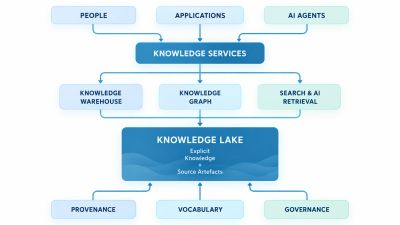
The term Knowledge Lake has an existing foundation in peer-reviewed research, where it was introduced as an extension of the Data Lake concept incorporating contextualised data and knowledge-oriented services.
Acta Laurel builds on this prior work by developing a file-oriented Knowledge Lake Reference Architecture focused on source artefacts and portable representations of explicit knowledge.
At its simplest, the architecture separates:
Source Artefacts
Original material from which knowledge may derive or to which knowledge refers.
Knowledge Concepts
Explicit, addressable representations of knowledge intended for durable use.
Workspace Artefacts
Working material that may contribute to knowledge but is not authoritative by default.
The architecture deliberately keeps the persistent foundation simple and portable.
Explore → Knowledge Lake
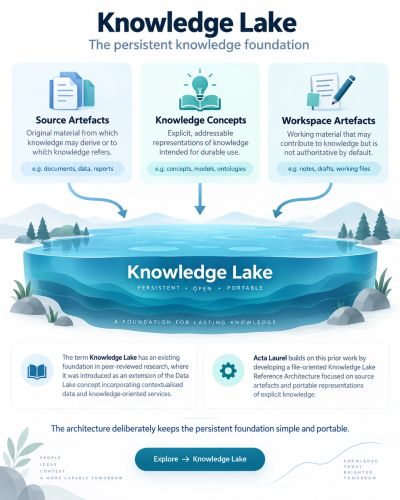
A reference architecture provides a reusable architectural foundation for a class of systems.
Acta Laurel's Knowledge Lake Reference Architecture defines the concepts, boundaries, principles and structural conventions from which concrete Knowledge Lake implementations can be created.
It allows the same underlying architecture to support different environments, including:
The reference architecture distinguishes carefully between established research, formal technical specifications and Acta Laurel's own architectural design decisions.
This matters.
Research informs the principles.
Standards define interoperable behaviour.
Architecture turns those principles into practical systems.
Explore → Reference Architecture
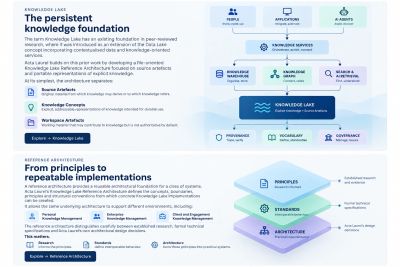
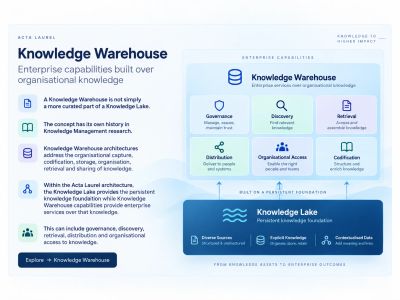
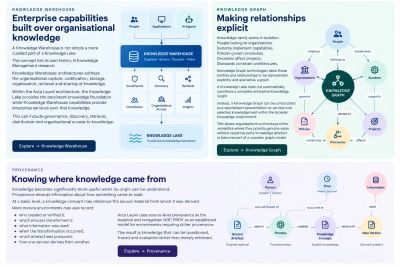
A Knowledge Warehouse is not simply a more curated part of a Knowledge Lake.
The concept has its own history in Knowledge Management research.
Knowledge Warehouse architectures address the organisational capture, codification, storage, organisation, retrieval and sharing of knowledge.
Within the Acta Laurel architecture, the Knowledge Lake provides the persistent knowledge foundation while Knowledge Warehouse capabilities provide enterprise services over that knowledge.
This can include governance, discovery, retrieval, distribution and organisational access to knowledge.
Explore → Knowledge Warehouse
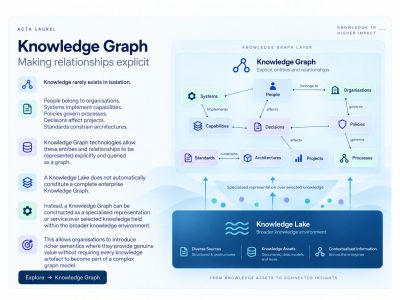
Knowledge Graph technologies allow these entities and relationships to be represented explicitly and queried as a graph.
A Knowledge Lake does not automatically constitute a complete enterprise Knowledge Graph.
Instead, a Knowledge Graph can be constructed as a specialised representation or service over selected knowledge held within the broader knowledge environment.
This allows organisations to introduce richer semantics where they provide genuine value without requiring every knowledge artefact to become part of a complex graph model.
Explore → Knowledge Graph
Knowledge becomes significantly more useful when its origin can be understood.
Provenance records information about how something came to exist.
At a basic level, a knowledge concept may reference the source material from which it was derived.
More mature environments may also record:
Acta Laurel uses source-level provenance as the baseline and recognises W3C PROV as an established model for environments requiring richer provenance.
The result is knowledge that can be questioned, traced and evaluated rather than merely retrieved.
Explore → Provenance
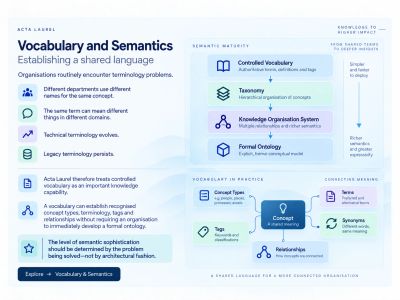
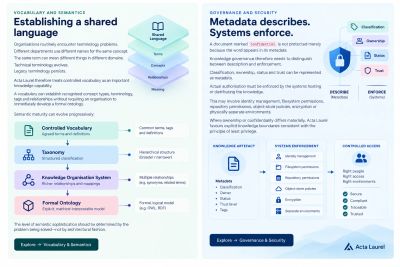
rganisations routinely encounter terminology problems. Different departments use different names for the same concept. The same term can mean different things in different domains. Technical terminology evolves. Legacy terminology persists.
Acta Laurel therefore treats controlled vocabulary as an important knowledge capability.
A vocabulary can establish recognised concept types, terminology, tags and relationships without requiring an organisation to immediately develop a formal ontology.
Semantic maturity can evolve progressively:
Controlled Vocabulary
│
▼
Taxonomy
│
▼
Knowledge Organisation System
│
▼
Formal Ontology
The level of semantic sophistication should be determined by the problem being solved—not by architectural fashion.
Explore → Vocabulary & Semantics
A document marked Confidential is not protected merely because the word appears in its metadata.
Knowledge governance therefore needs to distinguish between description and enforcement.
Classification, ownership, status and trust can be represented as metadata.
Actual authorisation must be enforced by the systems hosting or distributing the knowledge.
This may involve identity management, filesystem permissions, repository permissions, object-store policies, encryption or physically separate environments.
Where ownership or confidentiality differs materially, Acta Laurel favours explicit knowledge boundaries consistent with the principle of least privilege.
Explore → Governance & Security
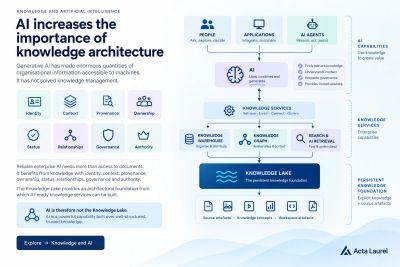
Generative AI has made enormous quantities of organisational information accessible to machines.
It has not solved knowledge management.
An AI system can retrieve a paragraph from a document without knowing whether that document is authoritative.
It can find conflicting statements without knowing which one governs.
It can generate an answer without knowing the provenance of the underlying knowledge.
It can infer relationships that an organisation has never formally established.
Reliable enterprise AI therefore needs more than access to documents.
It benefits from knowledge with:
The Knowledge Lake provides an architectural foundation from which AI-ready knowledge services can be built.
AI is therefore not the Knowledge Lake.
It is one of its most important consumers.
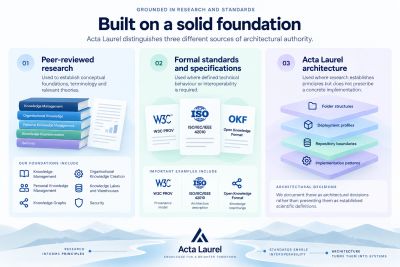
Peer-reviewed research
Used to establish conceptual foundations, terminology and relevant theories.
Our foundations include established work in Knowledge Management, organisational knowledge creation, Personal Knowledge Management, Knowledge Lakes, Knowledge Warehouses, knowledge representation, Knowledge Graphs and security.
Formal standards and specifications
Used where defined technical behaviour or interoperability is required.
Important examples include W3C PROV, ISO/IEC/IEEE 42010 and the Open Knowledge Format specification.
Acta Laurel architecture
Used where research establishes principles but does not prescribe a concrete implementation.
Folder structures, deployment profiles, repository boundaries and implementation patterns are architectural decisions.
We document them as such rather than presenting them as established scientific definitions.
The objective of knowledge architecture is not to create another repository into which organisations move all their information.
It is to establish a durable foundation connecting information, knowledge, people and machines.
The technology will continue to change.
The organisation's need to create, preserve, understand, trust and apply knowledge will not.
That is the problem the Acta Laurel Knowledge Architecture is designed to address.