Signed in as:
filler@godaddy.com
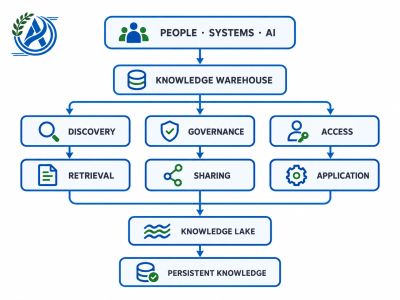
Knowledge Warehouse is an established term in Knowledge Management research. Nemati, Steiger, Iyer and Herschel proposed a Knowledge Warehouse architecture as an extension of the traditional Data Warehouse model.
Their work focused on supporting the capture, codification, storage, organisation, retrieval and sharing of organisational knowledge.
The underlying idea is powerful:
A Data Warehouse helps an organisation integrate and use data.
A Knowledge Warehouse helps an organisation integrate and use knowledge.
Acta Laurel adopts this architectural interpretation.
We do not use “Knowledge Warehouse” to mean a gold layer, curated folder or status assigned to individual knowledge documents.
The Knowledge Lake and Knowledge Warehouse solve different problems.
The Knowledge Lake is concerned primarily with persistence, portability, provenance and explicit knowledge representation.
The Knowledge Warehouse is concerned with making that knowledge available as an enterprise capability.
The Knowledge Warehouse therefore operates over the knowledge foundation.
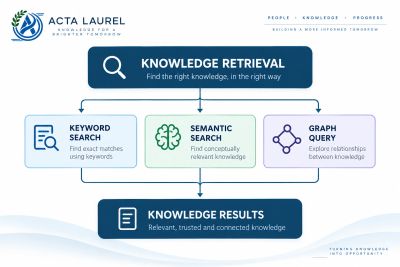
A Knowledge Warehouse should make knowledge findable. Retrieval can combine multiple approaches as show in the diagram. Different retrieval methods serve different problems. Keyword search is useful for precise terms. Semantic retrieval is useful when the wording differs. Graph retrieval is useful when relationships matter. hese capabilities can coexist.
Enterprise knowledge requires governance.
A Knowledge Warehouse can provide governance around:
Governance should be explicit enough that both people and systems can distinguish reliable organisational knowledge from drafts or obsolete material.
Knowledge only creates organisational value when it can move to where it is needed.
The Warehouse can expose knowledge through:
The same underlying knowledge can therefore serve multiple consumers without requiring each interface to maintain its own independent copy.
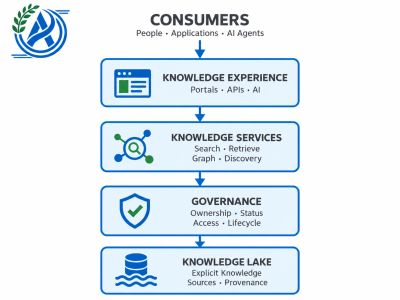
A Knowledge Warehouse does not need to be one monolithic product. It can be understood as a set of enterprise knowledge capabilities. This separation lets different technologies implement different capabilities without confusing the capability layer with the knowledge asset itself.
It is tempting to model knowledge like data engineering:
RAW → CURATED → WAREHOUSE
That is not the meaning Acta Laurel uses. The published Knowledge Warehouse concept is closer to an enterprise Knowledge Management system architecture. So the following interpretation is deliberately avoided:
Knowledge Lake
│
├── raw knowledge
├── curated knowledge
└── Knowledge Warehouse
Instead:
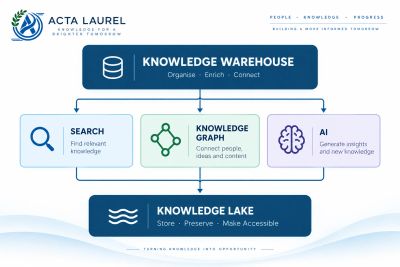
KNOWLEDGE WAREHOUSE → KNOWLEDGE SERVICES → KNOWLEDGE LAKE
The Warehouse operates over the Lake.
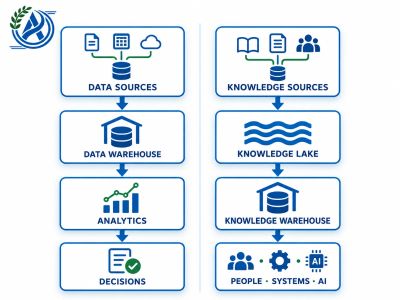
The Knowledge Warehouse concept was inspired by Data Warehousing, but the managed asset is different. A Data Warehouse is primarily designed around integrated, structured data for reporting and analysis. A Knowledge Warehouse is designed around codified organisational knowledge. The two can complement each other. An enterprise may operate both.
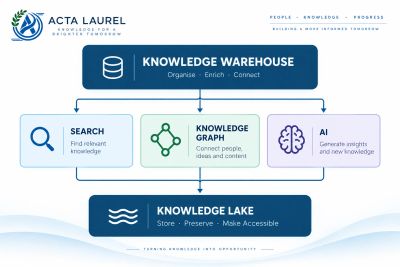
A Knowledge Graph can be one capability inside or alongside a Knowledge Warehouse. The graph provides rich entity and relationship representation. The Warehouse provides the broader enterprise capability for governed knowledge access and use. The graph is therefore not necessarily the Warehouse itself.
Search is necessary but insufficient. A search engine answers:
Where does this text appear?
A mature Knowledge Warehouse should be able to support broader questions:
That requires more than indexing. It requires identity, provenance, governance and explicit knowledge structure.
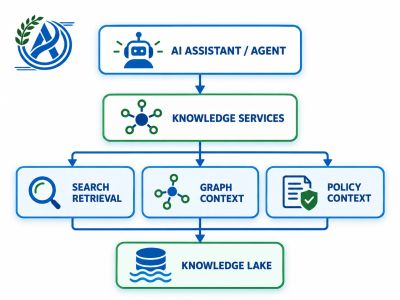
AI systems are becoming major consumers of organisational knowledge. A Knowledge Warehouse can provide a governed interface between enterprise knowledge and AI. This changes the role of Retrieval-Augmented Generation.
Instead of:
documents → chunks → vectors → LLM
an enterprise can move toward:
governed knowledge
│
├── provenance
├── status
├── ownership
├── relationships
└── access policy
│
→retrieval services
│
→ AI
The difference is not simply better embeddings. It is better knowledge governance.
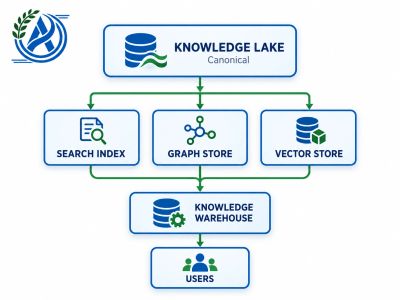
The Warehouse can make use of many derived systems:
These systems should not necessarily become the canonical knowledge source. Derived infrastructure can be replaced or rebuilt while the underlying knowledge remains intact.
A Knowledge Warehouse often needs to work across multiple business domains. For example we can see this on the image on the left. The Warehouse creates a common access and governance layer while allowing domain stewardship to remain distributed. This is important. Enterprise knowledge does not need to be centrally authored in order to be centrally discoverable.
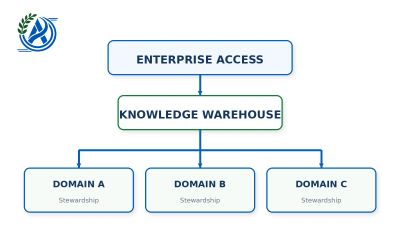
A mature Knowledge Warehouse should avoid creating a single knowledge team responsible for understanding everything. Domain experts remain responsible for domain knowledge. The Warehouse provides common mechanisms for managing and accessing it.
Conceptually we see this in the image on the left. This allows central architectural consistency without removing domain accountability.
Enterprise knowledge exists at different levels of maturity and authority.
Examples include:
DRAFT → REVIEWED →APPROVED / STABLE→DEPRECATED
The exact governance workflow can vary by organisation. The critical requirement is that consumers can distinguish status. An AI system should not silently treat an unreviewed meeting note as equivalent to an approved policy.
A Knowledge Warehouse can provide those signals to both people and machines.
The Warehouse must respect the security boundaries of the underlying knowledge. Central discovery does not imply universal access. A consumer may know that a knowledge resource exists without necessarily being authorised to read its contents.
Depending on the implementation, the Warehouse may enforce or integrate with:
The principle remains:
Knowledge should be discoverable and usable according to legitimate need, not simply because it exists.
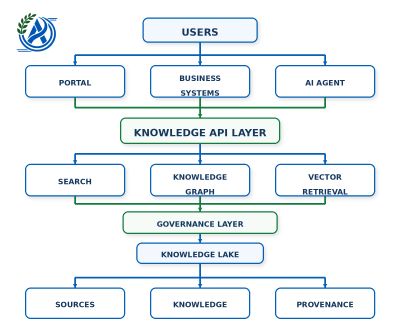
The image show a practical layered of a Enterprise Architecture in a simple state.
The exact technologies can vary. The architecture is defined by the responsibilities, not by product names.
An organisation can have thousands of documents and still have very little usable organisational knowledge. The difference is not storage capacity. The difference is whether knowledge can be:
The Knowledge Warehouse turns those capabilities into enterprise infrastructure.
The principal academic foundation for the Knowledge Warehouse concept is:
Nemati, H.R., Steiger, D.M., Iyer, L.S. & Herschel, R.T. (2002).
Knowledge warehouse: an architectural integration of knowledge management, decision support, artificial intelligence and data warehousing. Decision Support Systems, 33(2).
DOI: 10.1016/S0167-9236(01)00141-5
The paper proposes a Knowledge Warehouse architecture intended to support organisational knowledge capture, codification, storage, retrieval and sharing.
This is why Acta Laurel treats the Knowledge Warehouse as an enterprise Knowledge Management architecture rather than a document status or storage tier.
Alavi, M. & Leidner, D.E. (2001).
Review: Knowledge Management and Knowledge Management Systems: Conceptual Foundations and Research Issues.
MIS Quarterly, 25(1).
DOI: 10.2307/3250961
Their Knowledge Management framework identifies creation, storage/retrieval, transfer and application as fundamental knowledge processes.
The Knowledge Warehouse provides enterprise capabilities that support those processes.
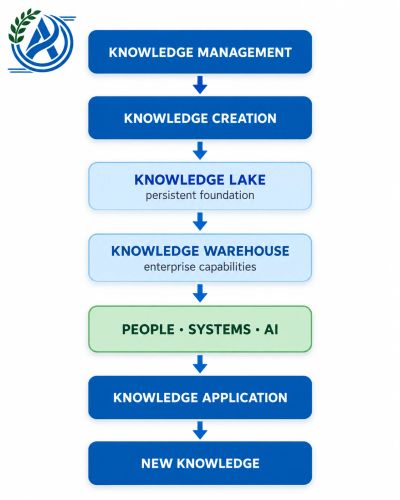
The relationship between the major concepts is therefore as the image demonstrate. This keeps the architecture conceptually clean. The Knowledge Lake is where durable explicit knowledge persists. The Knowledge Warehouse is how the enterprise operationalises that knowledge.